Written by Giulio Poggiaroni (Italian Military Archives). Originally published on Comando Supremo; republished on STAMAGE with the author’s permission.
The need for a sufficient number of dedicated escort ships led the Regia Marina to develop two series of escort vessels derived from the Spica-class torpedo boats.
From the Spica to the Pegaso
At the beginning of the 1930s the Italian Navy revived the torpedo boat, a type of warship that had spread widely at the turn of the 19th and 20th centuries but had then been progressively eclipsed by the torpedo-boat destroyer (later simply the destroyer). Italian naval planners saw the need for a new, modern torpedo boat able to ensure sea control and sea denial in the central Mediterranean, and in particular in the Sicilian Channel.
Building such small ships, officially displacing less than 600 tons, had two advantages: they were cheap, and they were not subject to the limits of the London Naval Treaty. This gave birth to the fast torpedo boats (torpediniere) of the Spica class, which saw very active service in the Second World War.
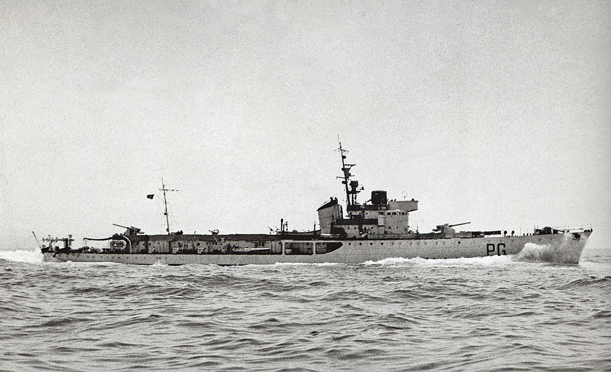
Between 1934 and 1935, with the first batch of Spicas under construction, the Navy realised that it needed a new type of vessel with greater range and seaworthiness, whose main role would be escort. General Bozzoni of the Naval Engineering Corps (Genio Navale) quickly reworked the Spica design into the Pegaso class. The ships were initially classified as avvisi scorta, essentially destroyer escorts, and later reclassified as torpediniere di scorta (escort torpedo boats), which suggests that the attack role, more prominent in the Spicas, was still retained.
The Pegasos were larger than the Spicas: their full-load displacement ranged from 1,630 tons in 1940 to 1,750 tons in 1943, against about 1,000 tons at full load for the Spicas. Overall length was 89.5 m, almost 8 m more than their predecessors.
The machinery (two boilers and two geared turbines) developed 16,000 hp (17,000–18,000 hp on trials), less than that of the Spicas, for a maximum speed of 28 knots on trials and 25–26 knots in service, more than enough for the roles then envisaged. Four ships were built.

The general layout of the Pegasos was similar to that of the Spicas. The main differences were the long deckhouse running from the after end of the forecastle to the stern, and the knuckle in the bow to improve seakeeping, a feature rarely seen on Italian ships. They carried two 100 mm guns instead of three, but had a larger ammunition reserve and could carry more depth charges. Their anti-aircraft and anti-submarine armament was improved several times during the war, increasing displacement in a way the ships handled easily. They were designed from the start to mount sonar sets, which were then under development in Italy but were not ready when the war began in 1940.
The Ciclone class
In late summer 1940 the Regia Marina concluded that more ships of the Pegaso type were needed to escort the heavy traffic to North Africa. A slightly modified design was approved: 14 ships were laid down in 1941 and two more in 1942, forming the new Ciclone class. They began entering service in mid-1942, built at record speed by the standards of Italian shipyards, some of them completed in 12 to 14 months.

Being built in wartime, the Ciclones suffered from hasty construction and poor-quality materials. Some ships could not reach the maximum speed of 25–26 knots required by the contracts, and their endurance was well below that of the Pegasos: 2,800 nautical miles instead of 4,000 at 14 knots, and 1,400 instead of 2,000 at 25 knots.
Their anti-aircraft armament was similar to that of the Pegasos and was steadily improved during the war, with some ships eventually mounting eleven 20 mm barrels.
Wartime service and losses
The four Pegaso-class ships fought relentlessly in the battle of the convoys and survived until the armistice between Italy and the Allies on 8 September 1943. Procione was then scuttled in dock at La Spezia to avoid capture by the Germans.

The other three sailed with the bulk of the Italian fleet. After the sinking of the battleship Roma, Orsa and Pegaso helped rescue the survivors and then headed for the Balearic Islands. Pegaso was scuttled to avoid internment in the Spanish harbour of Pollensa, while Orsa remained interned until January 1945. Orione reached Malta with the bulk of the fleet and served on the Allied side until 1945. Orsa and Orione stayed in service with the postwar Italian Navy, underwent an extensive refit in 1953 and served until the early 1960s.
Most of the Ciclones entered service in time for the battle of the convoys, and especially for its bloodiest phase on the Tunisian “route of death”. Six ships were lost in action (Ciclone, Tifone, Groppo, Uragano, Ardente and Monsone), and three were scuttled to avoid capture by the Germans or internment (Impetuoso, Ghibli and Intrepido). Two were captured and commissioned by the Kriegsmarine (Ardito and Impavido), while five survived and fought on the Allied side until 1945. After the war these five were handed over as war reparations: three to the USSR (Animoso, Ardimentoso and Fortunale) and two to Yugoslavia (Aliseo and Indomito).
Sources
- Brescia, M., Mussolini’s Navy: A Reference Guide to the Regia Marina 1930–1945, 2012.
- Pollina, P., Le torpediniere italiane, USMM, 1964.
- Ramoino, P.P., “Una scelta di strategia dei mezzi: le torpediniere della classe Spica”, Bollettino d’Archivio dell’Ufficio Storico della Marina Militare, April–June 2021.
Leave a Reply