Written by Giulio Poggiaroni (Italian Military Archives). Originally published on Comando Supremo; republished on STAMAGE with the author’s permission.
The ill-conceived belief that Greece would be easy prey for Fascist Italy led to the disastrous winter campaign of 1940, a deep embarrassment for Mussolini and a loss of prestige with his German ally. This article looks at the operations in the skies over Greece and Albania, from 28 October 1940 to April 1941.
Opposing forces
At this point the Regia Aeronautica was still relatively “fresh”. It had seen limited action in the campaign against France, while a small contingent based in Belgium was struggling in the operations against Britain. In North Africa the air war was growing harsher but was still limited in the number of aircraft involved, and relatively little effort was devoted to bombing Malta. In East Africa, the isolated Italian possessions were fighting an honourable but doomed battle.
Warned of the coming campaign at very short notice, the Regia Aeronautica fielded a variety of aircraft based in Albania and southern Italy. (In what follows, squadriglia corresponds roughly to a squadron, gruppo to a group and stormo to a wing.)
- Fighters: CR.32s, CR.42s and G.50s from eight squadriglie operating from Albania and four more operating from southern Italy, which also fielded a dozen Macchi C.200 Saettas of the 372ª Squadriglia.
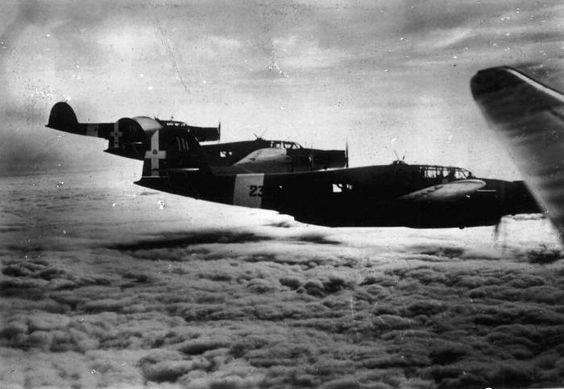
- Bombers: Junkers Ju 87B-2 and Ju 87R-1 Stuka dive bombers (96° and 97° Gruppo Autonomo), S.79 Sparvieros (12° and 46° Stormo), Fiat BR.20 Cicognas (13°, 18° and 37° Stormo) and CRDA Cant Z.1007bis (12°, 16° and 47° Stormo). Part of these forces only became available once the land operations were already under way, and most of them flew from southern Italy. A few S.M.81 bombers had been in Albania since the start of the war, but they were all soon replaced.
The Italian air effort was hampered by frequently adverse weather. Of the 176 days of the Greek campaign, 82 allowed no flying at all and another 30 permitted only a few hours of activity.
On the positive side, the Royal Hellenic Air Force (Elliniki Vasiliki Aeroporia) was not a strong opponent, as it fielded only a handful of aircraft: 21 fighters, mostly PZL P.24s and Bloch MB.151s divided into four flights, plus six Avia B.534s and two Gloster Gladiators, and 27 bombers, including Bristol Blenheim IVs, Potez 633s and Fairey Battles.
The air war
In the opening stage of the campaign the Italians flew a series of bombing missions against strategic targets such as Tatoi airfield, the Corinth Canal, the ports of Patras, Preveza and Thessaloniki, as well as road junctions and railway stations. As in other campaigns, this kind of bombing could not achieve decisive effects, and bad weather frequently grounded many aircraft.
On 1 November a relatively large raid, with some 200 aircraft including seaplanes, was flown against the same targets. However, the stalling of the Italian land offensive and the Greek counterattacks of early November forced the Regia Aeronautica to fly almost exclusively tactical support missions, aimed at stopping or delaying the Greek advance into Albania.
Meanwhile, the Greek air force used its limited means to bomb and strafe the Italian airfields in Albania, such as Valona, Durazzo and Tirana. By mid-November 1940 it had suffered heavy losses, and the British sent No. 80 Squadron RAF, equipped with Gloster Gladiator IIs, to reinforce the Greeks. On 19 November B Flight of No. 80 Squadron, joined by three Greek PZL P.24s, clashed with five CR.42s and a few G.50s over Koritza. Three Italian fighters and one British were lost.

Soon the British also committed a limited number of twin-engined bombers, Blenheims and Wellingtons, which, escorted by Gladiators, took an active part in the air war over Greece. Despite many problems and difficulties, however, the Regia Aeronautica managed to concentrate enough fighters and bombers to keep air superiority throughout the campaign.

In February 1941 the British sent in the first Hawker Hurricanes. On 20 February six of them, escorting 20 Blenheims against Berat airfield, clashed with the G.50s of the 154° Gruppo, which lost two aircraft in the fight.
Epilogue
With the Greek advance into Albania halted, the Italians launched an offensive in March that achieved very little. It once again saw fighters and bombers heavily committed to tactical support, on a scale probably unmatched on any other front where the Italians fought in the Second World War.
In April 1941 the German intervention in the Balkans was the turning point of the campaign, leading to the capitulation of Greece on 20 April.
No fewer than 700 Italian aircraft took part in the Greek campaign. The Regia Aeronautica lost 65 aircraft shot down and 14 destroyed on the ground, with 229 men killed or missing. It claimed 218 enemy aircraft destroyed in the air, while the number destroyed on the ground is unknown.
The Greek commander-in-chief, General Papagos, wrote of the Regia Aeronautica in this campaign:
“After the neutralisation of the limited possibilities of the poor Anglo-Greek air force, the Italian Air Force absolutely and uninterruptedly dominated the skies, and its continuous intervention both in battle and against the rear delayed and hindered the movements of the Greek troops, significantly limiting the possibilities of exploiting the successes. Furthermore, the movement of supplies was made more difficult, as we were forced to do it only at night.”
Sources
- De Lorenzo, G., “L’Aeronautica in guerra – 1° anno”, in L’Italia in guerra. Il primo anno – 1940, Commissione Italiana di Storia Militare, 1991, pp. 85–132.
- Galbiati, F., “La caccia della Regia Aeronautica (1936–1943), Parte I”, Storia Militare, 2023.
- Sgarlato, N., La Regia Aeronautica nella II Guerra Mondiale, Delta Editrice, 2000.
- Malizia, N., Il Fiat C.R.42, l’ultimo biplano da caccia italiano, Editrice Innocenti, 2003.
Leave a Reply